The chrysanthemum, the flower that counts the hours of darkness
Here it's the flower of the dead; in Japan, it's the emperor's symbol; in Australia, it's worn for Mother's Day. And it has a habit few people know about: to bloom, it doesn't follow the sun, it counts the darkness. If the night is too short, it waits.
The Rimmofatt! editors · November 14, 2026
Every autumn evening, out in the fields and greenhouses, a chrysanthemum is busy doing something nobody sees: counting. Not the hours of sunlight, as you might expect, but the hours of darkness. If the night is long enough, it starts getting its buds ready. If the night’s too short—or if someone turns on a light in the middle—it waits. That’s one reason you’ll spot it blooming at the start of November, when the nights have stretched out and almost everything else in the garden has called it quits.
That’s just the first odd thing about a flower that, around here, carries a bit of a gloomy reputation—but on the other side of the world, it’s the symbol of an emperor.
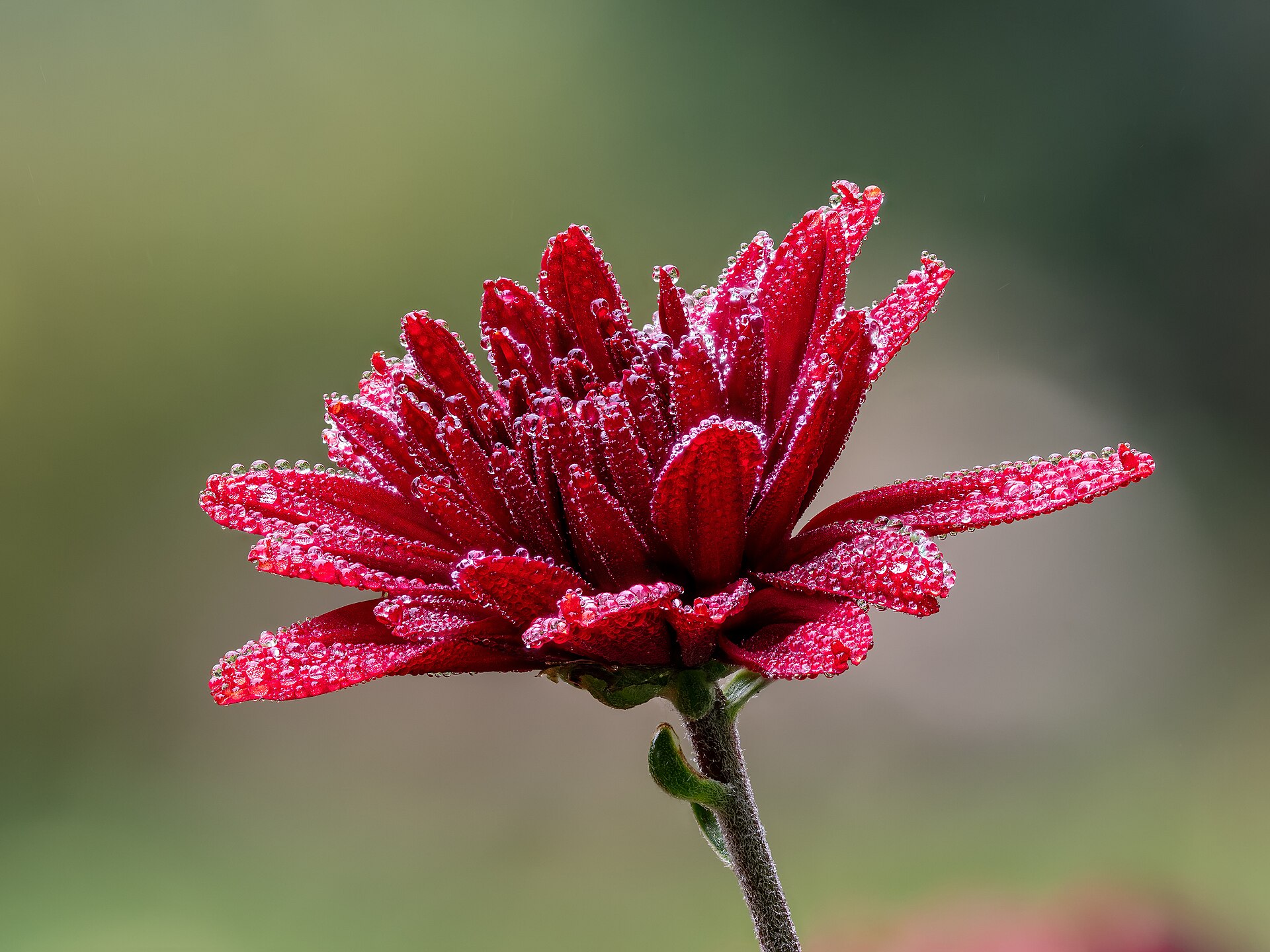
The Golden Flower
The name comes from Greek: chrysós for gold, and ánthemon for flower. The golden flower. Linnaeus made it official as the genus Chrysanthemum in 1753, and the florist’s chrysanthemums we know today are really hybrids, bred over centuries—mainly from two species native to China and Japan. One gave us the small-headed types, the other the big, showy ones that can top twenty centimeters across. The colors range from white to yellow, pink to deep red and purple, and even streaked varieties.
In China, people were growing chrysanthemums as far back as fifteen centuries before Christ, for both their blooms and their herbal uses. It’s one of the “Four Gentlemen” in Chinese painting, along with plum, orchid, and bamboo. During the Han dynasty, on the ninth day of the ninth month, people would drink chrysanthemum wine, convinced it would help them live longer. By 1630, there were already more than five hundred varieties.
The Emperor’s Flower
In Japan, chrysanthemums arrived from China around the fifth century, and their cultivation flourished in the centuries that followed. In the twelfth century, Emperor Go-Toba picked it as his family’s emblem. Ever since, the Japanese throne has had a name that would sound a bit odd to us: the Chrysanthemum Throne.
The imperial emblem is a yellow chrysanthemum with sixteen petals, with another sixteen staggered behind. In 1869, at the start of the Meiji era, the sixteen-petal design was reserved for the emperor; other members of the imperial family use a fourteen-petal version. A simpler form, with sixteen single petals, is stamped on the cover of Japanese passports and appears on embassies around the world.

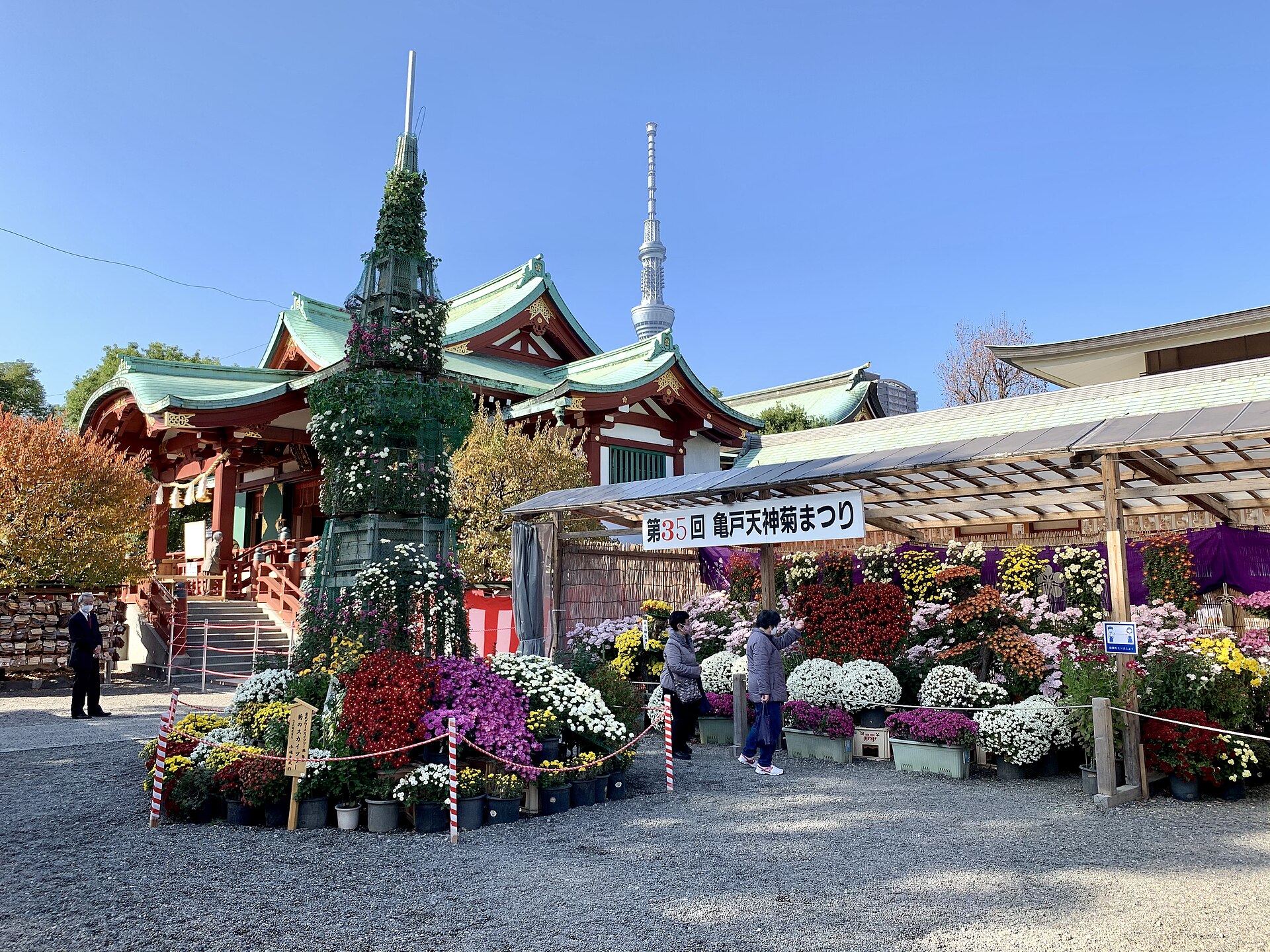
Over there, the chrysanthemum is a flower for celebrations. In autumn, shrines fill up with pots, towers, and flowery sculptures, and people go out of their way to see them—just like we might go see a nativity scene.
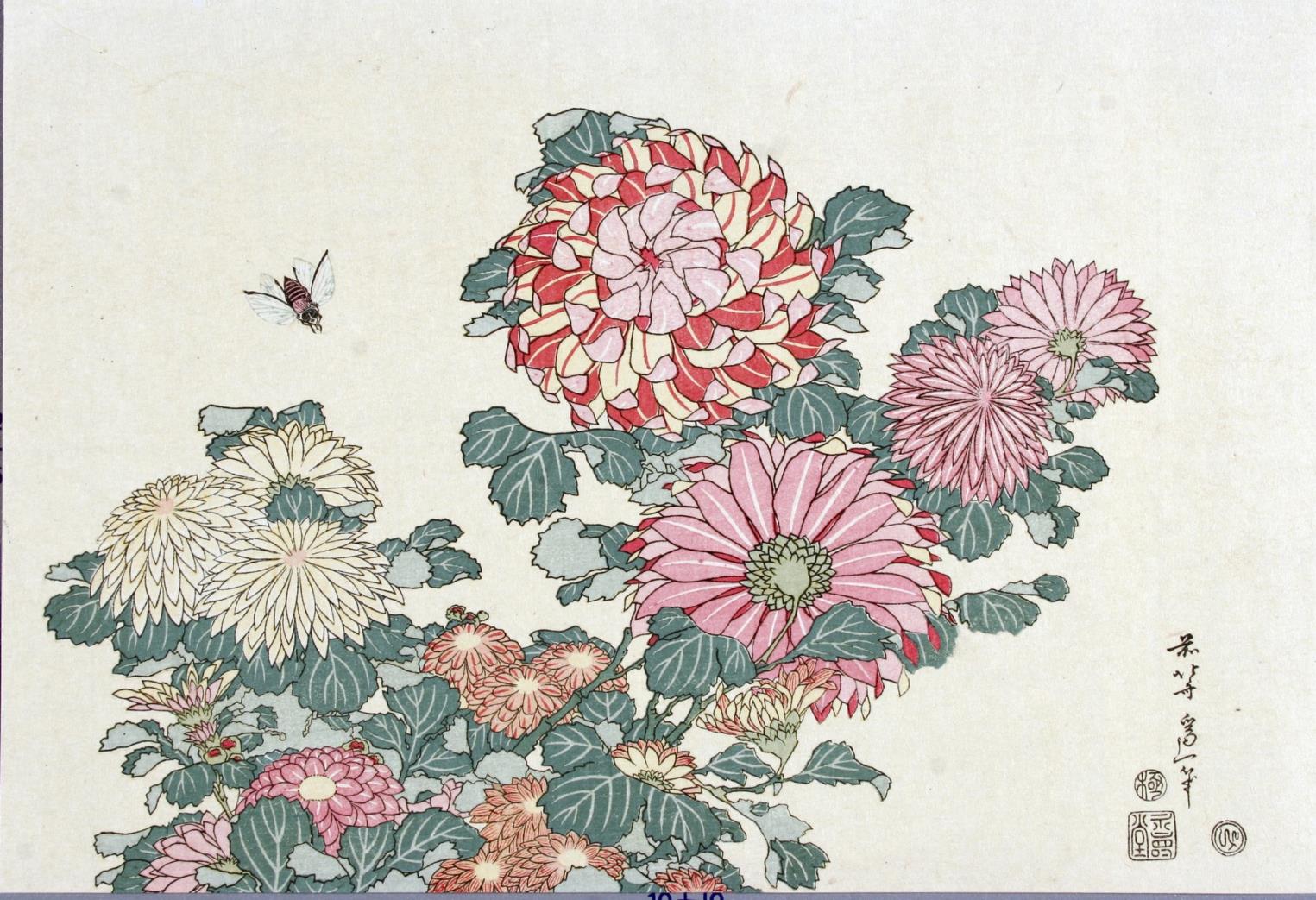
Even Hokusai, the artist behind the Great Wave, drew it more than once. In this print, the flower heads are huge, streaked with pink and red, and a bee is buzzing around.
Why It Ends Up in Cemeteries Here
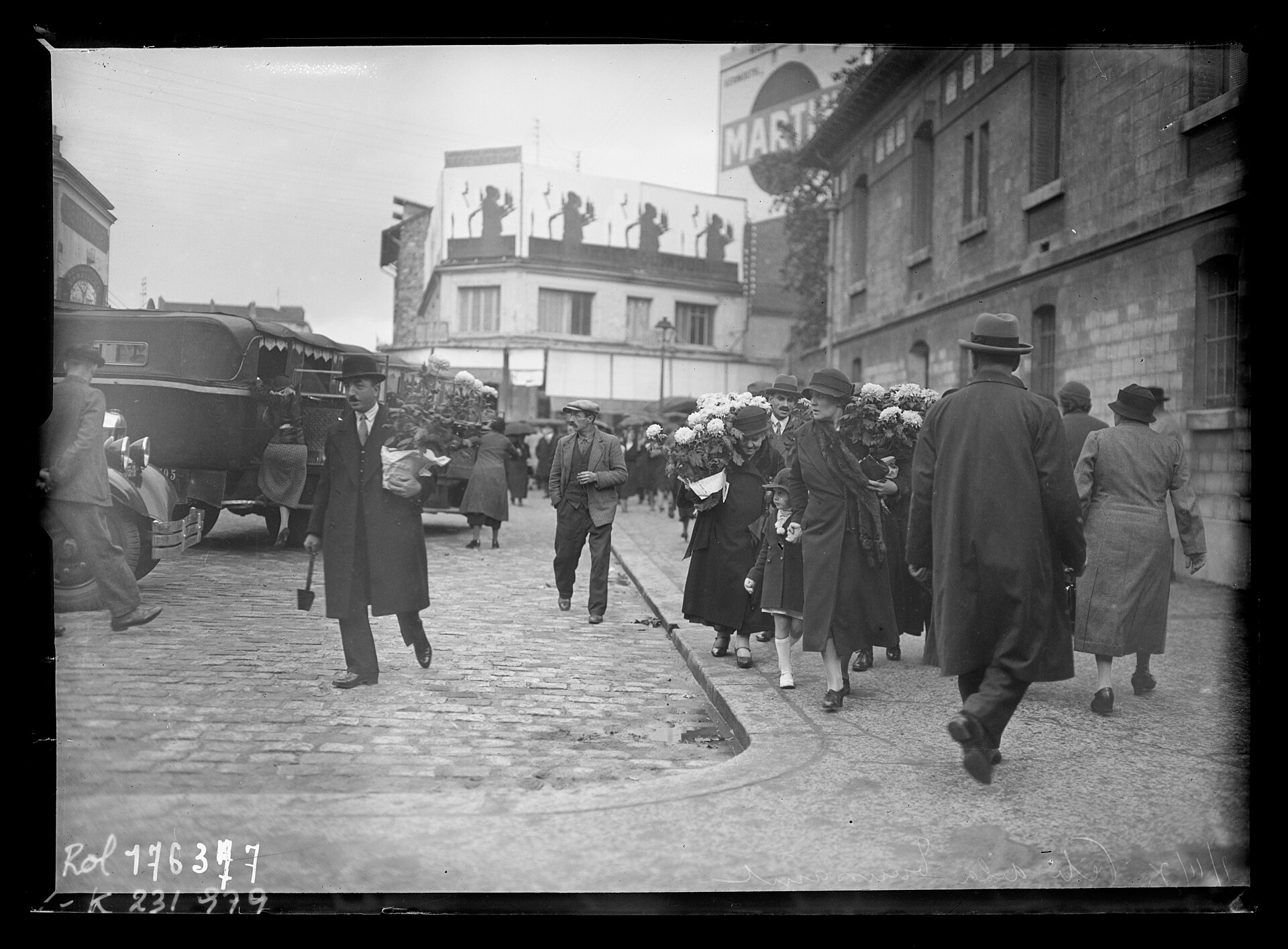
In Italy, the chrysanthemum is the flower you bring to the dead, and giving it as a gift is a social faux pas. The most likely reason is also the simplest: it blooms between late October and early November, right around All Saints’ Day and All Souls’ Day, when there aren’t many other flowers left. The same goes for France, Belgium, Spain, Poland, Hungary, and Croatia.
In France, the tradition even has a birthday. In 1919, for the first anniversary of the armistice, President Raymond Poincaré and Prime Minister Georges Clemenceau asked people to decorate the graves of fallen soldiers with flowers. Until then, graves were mostly adorned with candles. Chrysanthemums were chosen because they were in bloom at that time, when flowers were scarce, and the habit soon spread to all the dead and to All Saints’ Day. These days, over twenty-five million pots are sold in France every year, and nobody would dream of bringing one to a dinner party.
But cross a continent, and the meaning flips. In the United States, it’s mostly a cheerful, autumn flower. In Australia, come May, people pin on a white chrysanthemum for Mother’s Day: in English-speaking countries, the flower is often called “mum”—the same word Australians use for their moms.
The Flower That Counts the Dark
Now for the real oddity. The chrysanthemum is a “short-day” plant, but the name is misleading: what it really measures is the night. A study published in September 2022 in the journal Frontiers in Plant Science by Jingli Yang, Jinnan Song, and Byoung Ryong Jeong sums it up: the chrysanthemum only blooms when the night is longer than a certain minimum—otherwise, it holds off. The threshold is about twelve hours of darkness. The variety they studied, called ‘Gaya Glory,’ blooms with at least thirteen hours of darkness and won’t bloom if it gets less than twelve.
And the count is a delicate one. Just a bit of red light in the middle of the night, the authors note, is enough to stop the blooming: for the plant, it’s as if the night got shorter. The study adds another twist: the researchers tried blue light, shining it at the end of the day or in the middle of the night, at different intensities. A moderate blue light encouraged blooming; given at the end of the day, it did so even when the days were long. Stronger blue light, though, held it back again. So the flower isn’t just counting hours—it’s also paying attention to what kind of light it gets, and how much.
An Elegy and an Insecticide
Giacomo Puccini named one of his most melancholy pieces after the chrysanthemum. In January 1890, Amadeo of Savoy, son of Victor Emmanuel II and former king of Spain, died. Puccini, the story goes, wrote an elegy for string quartet, “Crisantemi”, in a single night. It was first performed on January 26, 1890, and Puccini later reused its themes in Manon Lescaut.
And there’s a chrysanthemum that works for a living. From one of its close relatives—now called Tanacetum cinerariifolium—we get pyrethrins, the natural insecticides in pyrethrum: they’re extracted from its tiny dry fruits.
So that chrysanthemum you see by the cemetery gates in November isn’t there by accident, or even out of sadness. It’s there because the nights have finally grown long enough. It’s counted the darkness, and decided it’s time.
How the Smorfia reads it
'E sciureFlowers
The chrysanthemum is a flower, and in the Smorfia, flowers mean beauty that doesn’t last and a gift. But this one blooms when the others are done, and around here, you don’t give it as a present: it ends up on graves.
'O muortoThe dead man
It's the flower of the dead: it shows up in cemeteries for All Saints' Day and All Souls' Day, because that's when it blooms. And in the Smorfia, death isn't only an end: it's also a transformation.
'A mammaMother
In Australia, for Mother's Day, people wear a white chrysanthemum: in English the flower is often called “mum”, the same word Australians use for their mothers. On the other side of the world, the same flower is a good wish.
Where it comes from
Sources and further reading7 sources · 5 news outlets
More true stories
Rimmofatt! is symbolic entertainment. It doesn't predict winnings, doesn't increase your chances of winning and doesn't take bets. It is not a gambling service.